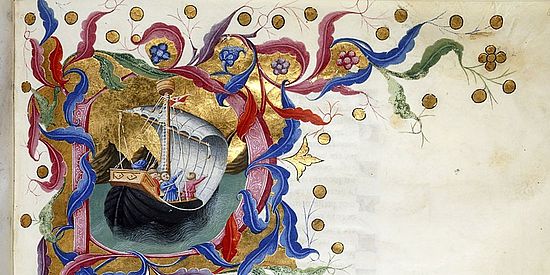
The Italian-speaking world – the cradle of the Renaissance, the birthplace of opera, and a past and present destination for travelers seeking to discover the region's beauty, cuisine, and art – reaches from Italy into Switzerland and is also present internationally. For students of Italian language and literature, the study of this singular world in historical and contemporary contexts involves such wide-ranging themes as literature, communication, history, society, and culture.
Italian Studies in Basel consists of two academic fields. On the basis of contemporary linguistic theory, the program's courses in Italian linguistics consider the Italian language and its use in a wide range of historical, social, and communicative contexts. The subject area's courses in literary studies address literary culture in the Italian language from the Middle Ages to the present. Literary works are analyzed in the original language and read in the context of a broader historical and cultural perspective.
Italian Studies at the University of Basel is divided into two sections: literary studies and linguistics.
The study of Italian-language literature in Basel focuses on the literature and culture of Italy and Ticino from the Middle Ages to the present day. The curriculum first addresses literature with textual analysis and then offers historical, cultural, social, and anthropological contextualization. The subject area’s focuses include narrative forms and their relationship to Italian society; the study of texts in their theatrical and performative realizations (theater and opera); and literary society and mediation (academies, newspapers, journals, and intellectual history).
The first goal of the Bachelor curriculum in Italian linguistics is to identify the specific features of the Italian language in comparison to other contemporary languages. The second goal is to address the linguistic variations of the Italian language itself in the contexts of time, space, society, and communication. Depending on the context, this can include consideration of intonation, vocabulary, syntax, punctuation, and the organization of texts.
Our Bachelor curriculum gives students a foundation in the academic study of the primary fields of Italian literary studies and linguistics. Courses in literary studies are framed in terms of larger developments in aesthetics and literary theory, with literary analyses that put particular emphasis on how aspects of cultural history, anthropology, and society are represented in literary texts. Courses in linguistics focus on functional linguistics, a field in which linguistic structures are considered in terms of their communicative functions.
The Bachelor curriculum includes such modules as the Foundations in Italian Literary Studies; the Foundations in Italian Linguistics; Language Skills, including Writing and Communicative Skills; the Analysis of Literary Texts; the History of the Italian Language; and the Literary and Linguistic Methods and Tools.
The courses are taught in Italian.
| Degree | BA in Italian Language and Literature |
| Type | Subject |
| Start date | February, September |
| Credit points | 180 |
| Study structure | The Bachelor's degree is the first degree before the Master's degree and comprises a total of 180 credit points (CP). Italian Studies is studied as one of two subjects, each worth 75 CP. In addition, there is the free elective area (30 CP). One ECTS credit point corresponds to approximately 30 hours of work. |
| Subject combination | In addition to subjects from the Faculty of Humanities and Social Sciences, a non-faculty subject is also possible as a second Bachelor's subject. The free elective area is available to all students. It is generally used to acquire general skills (foreign languages, IT, rhetoric, etc.), for interdisciplinary learning (non-subject or interdisciplinary courses), to further deepen your own subject studies or to acquire a certificate. |
| Language of instruction | Italian |
| Subject area | Italian Linguistics and Literary Studies |
The Student Administration Office at the University of Basel is responsible for admitting students to bachelor’s programs in the Faculty of Humanities and Social Sciences. This is based on the admission regulations of the President’s Office:
Holders of a Swiss federal Maturität certificate will be admitted to all bachelor’s degree programs.
If you have any further questions, please consult the information provided here.
Students must register for their bachelor’s or master’s degree program within a specified timeframe – even in cases of delayed registration.
The University of Basel organizes regular information events for bachelor’s and master’s programs. Details can be found on the events page of the Faculty of Humanities and Social Sciences.
Some subject areas also offer their own separate information or welcome events. Please consult the page for the relevant subject area for event dates and locations.
Students who have earned 60 CP in the subject to be examined or 120 CP in the degree program and have completed the seminar papers that count towards the degree in the subject to be examined or in the degree program may register for the Bachelor's examination. Proof is provided by submitting the module assignment.
Only one subject per session can now be examined. This means that the two Bachelor's examinations can be spread over two sessions (note: only for subjects - it is not possible to separate the two examinations for degree programs).
BA examinations: Due to the free availability of AI text generators (such as ChatGPT), the Faculty of Phil.-Hist. has decided to adapt the way in which the BA examination is conducted. This adjustment is intended to ensure that students are able to do their own work. From spring semester 2023, the BA examinations will once again be written in the university rooms under supervision. These will be digital "bring-your-own-device" examinations. The examination dates remain unchanged.
Please note the updated information sheet on the procedure for BA examinations and the new registration form (subject, degree program). If you have any questions, please contact the Student Administration.
After completing a Bachelor's degree in Italian Studies, in addition to the Master's degree in Italian Studies (in combination with a second Master's degree subject), students can also consider the interdisciplinary Master's degree course in Language and Communication or the multilingual Master's degree course in Literary Studies. Both of these are studied without a second subject.
Graduates who are interested in the teaching profession can study for a teaching diploma. For details and teaching diploma regulations, please consult the relevant school for teacher education or the Swiss Conference of Cantonal Ministers of Education.