

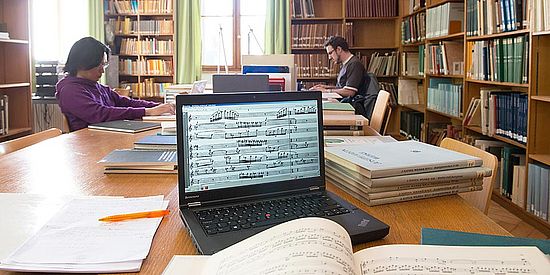
Musicology (Bachelor's degree subject)From Medieval Chants to Classical Modernism to Rock and Pop
Musicology deals with the history of music from the beginnings of written records in the 9th century, through classical modernism to rock and pop. In addition to the historical perspective, Bachelor's students are introduced to the basics of music theory, music analysis and music aesthetics. The course serves the understanding and interpretation of music in the broadest sense. It provides insights into the various prerequisites and manifestations of music, its interrelationships with other arts and its role in society. The subject of study is everything that falls under the term music, in particular written text and music sources, images, musical instruments and sound recordings. Basel not only offers its students a sound musicological education, but also enables them to work on practice-oriented, educational projects such as the conception of exhibitions or the production of program booklets and CD booklets.
Focal areas of teaching and research
At the University of Basel, musicology is taught primarily as a historical discipline (from the Middle Ages to the present day, including rock, pop and jazz), supplemented by other areas of musicology. Special attention is paid, for example, to aesthetic issues and the close connection between cultural studies and philological aspects of music.
It is also important for students to gain an insight into professional musicology practice during their studies and to be able to work on relevant projects. This is possible thanks to the dense network of music-related institutions in Basel with which the subject area of Musicology cooperates. The proximity to the Paul Sacher Foundation is of central importance for modern music history, as is the neighboring Schola Cantorum Basiliensis and the Music Museum for all questions of historically informed performance practice. In combination with the rich concert and theater life of the music city of Basel, these are ideal conditions for a fruitful interaction between research, teaching and artistic and academic professional practice.
Basic knowledge of music theory (including harmony) and the ability to deal with a musical text are required for the Bachelor's degree course. Musical experience, for example in the form of practical musical training, is also helpful. Individual requirements are discussed at the start of the course. Missing basics can be made up in supplementary courses. It should also be noted that knowledge of modern foreign languages, particularly English, but also French and Italian and, depending on the focus of interest, other languages (e.g. Latin for early music) is required for the study of specialist literature and sources. Attendance of appropriate courses, such as those offered at the Language Center of the University of Basel and the individual subjects of the Faculty of Humanities and Social Sciences, can be credited in the complementary area.
Short profile
| Degree | BA in Musicology |
| Type | Subject |
| Start date | February, September |
| Credit points | 180 |
| Study structure | The Bachelor's degree is the first degree before the Master's degree. It comprises a total of 180 credit points (CP). The subject of musicology is studied with a second subject and a free elective area. 75 CP are earned in each of the two subjects and 30 CP in the free elective area. One credit point (CP) ECTS corresponds to approximately 30 hours of work. |
| Combination of subjects | Musicology allows for many profitable combinations with other subjects. In addition to subjects from the Faculty of Humanities, a non-faculty subject is also possible as a second Bachelor's subject. The free elective area is freely available to all students. It is generally used to acquire general skills (foreign languages, IT, rhetoric, etc.), for interdisciplinary learning (non-subject or interdisciplinary courses), to further deepen one's own subject studies or to acquire a certificate. |
| Language of instruction | German, English |
| Subject area | Musicology |
Bachelor’s admission requirements
The Student Administration Office at the University of Basel is responsible for admitting students to bachelor’s programs in the Faculty of Humanities and Social Sciences. This is based on the admission regulations of the President’s Office:
- with Swiss educational qualifications,
- foreign educational qualifications, or
- as a visiting student (not working toward a degree at the University of Basel)
Holders of a Swiss federal Maturität certificate will be admitted to all bachelor’s degree programs.
If you have any further questions, please consult the information provided here.
Registration dates
Students must register for their bachelor’s or master’s degree program within a specified timeframe – even in cases of delayed registration.
Information events
The University of Basel organizes regular information events for bachelor’s and master’s programs. Details can be found on the events page of the Faculty of Humanities and Social Sciences.
Some subject areas also offer their own separate information or welcome events. Please consult the page for the relevant subject area for event dates and locations.
Deadlines and dates for the Bachelor's studies
Students who have earned 60 CP in the subject to be examined or 120 CP in the degree program and have completed the seminar papers that count towards the degree in the subject to be examined or in the degree program may register for the Bachelor's examination. Proof is provided by submitting the module assignment.
Only one subject per session can now be examined. This means that the two Bachelor's examinations can be spread over two sessions (note: only for subjects - it is not possible to separate the two examinations for degree programs).
BA examinations: Due to the free availability of AI text generators (such as ChatGPT), the Faculty of Phil.-Hist. has decided to adapt the way in which the BA examination is conducted. This adjustment is intended to ensure that students are able to do their own work. From spring semester 2023, the BA examinations will once again be written in the university rooms under supervision. These will be digital "bring-your-own-device" examinations. The examination dates remain unchanged.
Please note the updated information sheet on the procedure for BA examinations and the new registration form (subject, degree program). If you have any questions, please contact the Student Administration.
Examinations & graduation
Further Master's studies
The Bachelor's degree entitles students to a subsequent Master's degree. This can also be completed in a different subject area, depending on the use of the elective area in the Bachelor's degree
- Master of Arts in Musicology (can be combined with a second Master's degree subject)
Teaching diploma
Graduates who are interested in the teaching profession can study for a teaching diploma for the lower secondary level (Sekundarstufe I) or upper secondary level (Sekundarstufe II). For details and teaching diploma regulations, please consult the relevant school for teacher education (such as the FHNW School of Education) or the Swiss Conference of Cantonal Ministers of Education.
When studying School Music II C at the FHNW School of Music (HSM), the academic part of a full Bachelor's degree in Musicology (without a second subject and without a complementary area) is delegated to the University. School Music II C students are enrolled at the HSM of the FHNW, where they must also pass the entrance examination, and take their coursework at the university as tuition-free students. Please find out more about the details and applicable regulations for the Music Education with a major in School Music II at the HSM of the FHNW.
Student advisory service
Teaching commission
Quick Links