

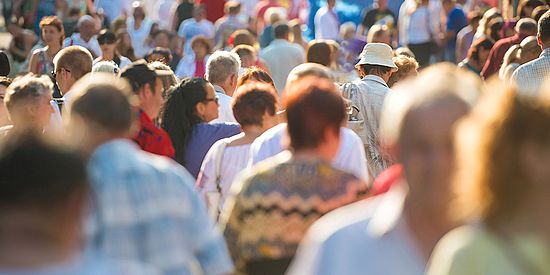
Changing Societies (Master’s Degree Program)Multidimensional Research into Societal Change
Societies are dynamic, diverse, and complex. Contemporary transformations are evident in many areas: in the changing role of nation-states in relation to international organizations and global markets; in economic and technological shifts and the transformation of the world of work; in profound social, demographic, and cultural changes; as well as in new forms of migration and mobility of people, goods, capital, and ideas. These developments are accompanied by global challenges such as the management of scarce resources and the search for more sustainable solutions.
The Master’s degree program Changing Societies addresses these transformations. It examines the related questions, potentials, and challenges, and provides students with a solid understanding of processes of societal change.
To capture the complexity of these developments, the program brings together different perspectives from the social sciences. As an interdisciplinary program, it combines theoretical approaches and methodological tools from various disciplines. Students benefit from both a broad substantive education and a solid training in qualitative and quantitative methods of empirical social research.
In this way, they acquire the skills to analyze societal change in a systematic and scientifically grounded manner—an essential foundation for understanding contemporary challenges and contributing to their solutions.
Focal areas of teaching and research
The Master’s degree program Changing Societies brings together lecturers from the following social science disciplines:
- Social Anthropology
- Gender Studies
- Cultural Anthropology
- Sustainability Research
- Near and Middle Eastern Studies
- Political Science
- Sociology
Based on these disciplinary perspectives, the program offers three analytical focus areas, of which students choose two:
Bodies, Objects, Circulation
This module explores mobility and circulation in a globalized world. It focuses on the movements of people, objects, ideas, and capital, as well as the associated dynamics of power, inequality, and negotiation in both local and transnational contexts.
Sustainable Societies: Inequality, Power, Conflict
This module addresses issues of inequality, political power, resource distribution, and conflict. It combines theoretical approaches from political science and international relations with empirical methods to analyze contemporary challenges such as climate change, sustainability, and peacebuilding.
Global Modernity and Difference
This module examines the global dimensions of modernity and the interplay between integration and difference. It engages with different paths of modernization and explores how culture, gender, class, and ethnicity shape global inequalities.
Short profile
| Degree | MA in Changing Societies |
| Type | Degree program |
| Start date | February, September |
| Credit points | 120 |
| Study structure | The Master's degree is the second degree after the Bachelor's degree and comprises a total of 120 credit points (CP). The Changing Societies master's degree program is a single major degree without any other subjects, which is completed with 100 CP. In addition, there are free electives with 20 CP. One ECTS credit point corresponds to approximately 30 hours of work. |
| Subject combination | The Changing Societies master's degree program is studied without a second degree subject. The 20 CP for the free electives can be gained in courses of your choice (please check entry requirements of the respective courses). They can be used to deepen knowledge in the degree subjects, gain insights into other degree subjects offered by the University of Basel or acquire language skills. |
| Language of instruction | German, English |
| Department | Department of Social Sciences |
Master’s admission requirements
Admission to master’s programs is regulated by the university student regulations and the stipulations of the individual degree program descriptions. More details of the general master’s admission requirements are provided here.
For students to be admitted with no additional requirements, they must hold a bachelor’s degree worth 180 CP from a higher education institution recognized by the University of Basel.
Subject-related requirements are defined in the admission requirements (section 3) of the study program for the relevant subject. The guidelines may also contain further useful information that is key to successful studies.
Registration dates
Students must register for their bachelor’s or master’s degree program within a specified timeframe – even in cases of delayed registration.
Information events
The University of Basel organizes regular information events for bachelor’s and master’s programs. Details can be found on the events page of the Faculty of Humanities and Social Sciences.
Some subject areas also offer their own separate information or welcome events. Please consult the page for the relevant subject area for event dates and locations.
Deadlines and dates for the Master's studies
See also factsheets under Documents & Factsheets.
Master's thesis
Master's examinations for students of the subject and degree program
Master's degree
All data subject to subsequent changes.
Career opportunities
The MA in Changing Societies prepares students for both academic and non-academic careers. When a specific thematic focus is chosen, there is a possibility to continue towards gaining a PhD in one of the disciplines which make up the program. Alternatively, graduates of the program can choose from numerous exciting fields of employment outside higher education, such as international organizations, NGOs, politics, public administration, or culture and knowledge management. The program also qualifies students for careers that call for independent thinking and sound methodological and analytical skills, even if not directly linked to the thematic focus of Changing Societies.
Academic advice
Teaching committee
Quick Links