

European Archaeology (Master's Degree Subject)How early cultures lived
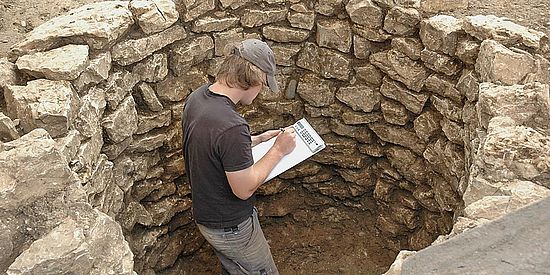
Prehistoric Archaeology investigates societies from non-literate or sparsely literate periods, spanning a temporal range from the beginnings of human history to the early Middle Ages. The principal sources for studying their ways of life and cultural practices are the material remains recovered through excavation – most notably artefacts, architectural traces, and ruins. The second major pillar of the Master’s subject is Provincial Roman Archaeology, which focuses on finds and contexts from the Roman provinces. Like Prehistoric Archaeology, it centres on reconstructing everyday life as well as the dynamics of change and continuity among provincial populations, drawing primarily on the material record. Both specialisations place particular emphasis on Switzerland and the surrounding regions.
Focal areas of teaching and research
At Basel, European Archaeology is practised as “Integrative Archaeology,” combining approaches from the humanities and the natural sciences. As a culturally oriented humanities discipline situated within Ancient Studies, it works closely with Archaeological Sciences in both teaching and research. Key research areas in prehistory and early history include social, gender, and childhood history. In Provincial Roman Archaeology, major research foci are Vindonissa (Brugg/Windisch; civilian settlements and their interactions with the legionary base) and Augusta Raurica (Kaiseraugst; including the architectural development of residential and commercial districts).
In the Master’s study, students deepen their knowledge of prehistoric, early historic, and provincial Roman periods; engage critically with the diverse theories and methods of the field; analyse archaeological finds and features; and acquire profession-oriented practical skills. Equal emphasis is placed on communication and mediation competencies, which are essential in the professional life of archaeologists. Negotiation skills, for example, are required in research collaborations, scholarly debates, or rescue excavations involving construction firms, while mediation skills are crucial when communicating archaeological knowledge to audiences such as journalists, school groups, policymakers, and the general public.
Short profile
| Degree | MA in European Archaeology |
| Type | Subject |
| Start date | February, September |
| Credit points | 120 |
| Study structure | The Master's degree is the second degree after the Bachelor's degree and comprises a total of 120 credit points (CP). European Archaeologyis studied at Master's level in combination with a second, independent subject, each worth 35 credit points. The subject in which the Master's thesis (30 CP) is written becomes a major, the other a minor. This is supplemented by the free elective area (20 CP). One credit point (CP) ECTS corresponds to approximately 30 hours of work. |
| Subject combination | A subject from the Faculty of Humanities and Social Sciences or a non-faculty subject can be considered as a second Master's subject. Students can choose it according to their interests and professional goals. The free elective area consists of freely selectable courses that can be used to deepen knowledge of the subjects, to gain insight into other subjects offered by the University of Basel or to acquire language skills. |
| Language of instruction | German, English |
| Subject area | European Archaeology |
Master’s admission requirements
Admission to master’s programs is regulated by the university student regulations and the stipulations of the individual degree program descriptions. More details of the general master’s admission requirements are provided here.
For students to be admitted with no additional requirements, they must hold a bachelor’s degree worth 180 CP from a higher education institution recognized by the University of Basel.
Subject-related requirements are defined in the admission requirements (section 3) of the study program for the relevant subject. The guidelines may also contain further useful information that is key to successful studies.
Registration dates
Students must register for their bachelor’s or master’s degree program within a specified timeframe – even in cases of delayed registration.
Information events
The University of Basel organizes regular information events for bachelor’s and master’s programs. Details can be found on the events page of the Faculty of Humanities and Social Sciences.
Some subject areas also offer their own separate information or welcome events. Please consult the page for the relevant subject area for event dates and locations.
Deadlines and dates for the Master's studies
See also factsheets under Documents & Factsheets.
Master's thesis
Spring semester 2025
Master's examinations for students of the subject and degree program
Spring semester 2026
Master's degree
Fall semester 2025
All data subject to subsequent changes.
Career opportunities
The cantonal archaeologies form the largest labor market, followed by museums, private excavation companies and universities. The majority of Basel graduates have so far successfully found a job in one of these fields.
Thanks to key qualifications such as communication and mediation skills, archaeologists also have further career opportunities in the fields of publishing, cultural mediation, tourism, journalism and advertising. Those interested in an academic career can find out more about doctoral studies.
Student advisory service
Teaching commission
Quick Links