

Ancient History (Master's Degree Subject)Studying the Greek and Roman Worlds in All Their Diversity
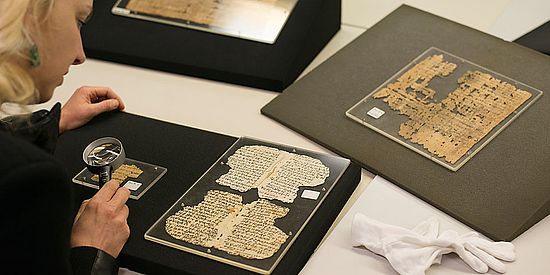
The Master’s degree subject in Ancient History at the University of Basel examines Greek and Roman cultures from their earliest beginnings to the end of Antiquity. It is guided by the questions and perspectives that define historical scholarship and is closely connected to linguistic, literary-theoretical, visual, and cultural approaches within the wider field of Classical Studies. The study is concerned with the manifold ways in which individuals and communities shaped, experienced, and interpreted their world. Themes include family, household, economy, religion, demography, science, politics, as well as patterns of exchange, distinction, and integration among ancient cultures. Through historically grounded analyses that remain attentive to the present, students learn to identify continuities and ruptures over time. Particular emphasis is placed on how images of antiquity are continually reshaped and mobilised to orient and legitimise contemporary discussions.
Focal areas of teaching and research
In Basel, Ancient History is taught in its full breadth. Key areas of research and teaching include:
- Greek and Roman history
- History of the family
- House and household in antiquity
- Social, economic, and religious history of Greco-Roman Egypt
- Papyrology
- Ancient everyday life
- Ancient demography
- Early Christianity
- Late Antiquity and the early Byzantine world
- History of science and historiography
- Historical climatology and ancient DNA analysis
Beyond subject-specific expertise, the degree subject equips students with skills of broad professional relevance: the ability to write scholarly texts, to work independently in complex fields, to locate and synthesise information efficiently, to analyse and present intricate issues, to recognise and formulate research problems, to engage critically with multiple perspectives, and to communicate meaning clearly and coherently.
Short profile
| Degree | MA in Ancient History |
| Type | Degree subject |
| Start date | February, September |
| Credit points | 120 |
| Study structure | The Master's degree subject comprises a total of 120 credit points (CP). Ancient History is studied in combination with a second subject, each worth 35 CP. The subject in which the Master's thesis (30 CP) is written is regarded as a major, the other as a minor. In addition, there is a free elective area (20 CP). One ECTS credit point corresponds to approximately 30 hours of work. |
| Subject combination | A subject from the Faculty of Humanities and Social Sciences or a non-faculty subject can be considered as a second Master's subject. Students can choose it according to their interests and professional goals. The free elective area consists of freely selectable courses that can be used to deepen knowledge of the subjects, to gain insight into other subjects offered by the University of Basel or to acquire language skills. |
| Language of instruction | German, English |
| Subject area | Ancient History |
Latinum/Graecum
Knowledge of Latin and Greek is required for the Master's degree course in Ancient History. Students who do not have a sufficient knowledge of Latin can acquire this as part of the Latinum annual course or the Latin summer school, which is subject to a fee. Any lack of knowledge of Greek can be acquired as part of the Graecum year course. All three courses are validated with 12 CP in the complementary area. Proof of knowledge of Greek and Latin in accordance with the guidelines must be provided when registering for the Master's thesis.
Further language skills
German is a central academic language in Ancient History. In addition, the ability to read and understand texts in other modern academic languages such as English, French and Italian is important. Students should be prepared to expand their language skills if necessary.
Master’s admission requirements
Admission to master’s programs is regulated by the university student regulations and the stipulations of the individual degree program descriptions. More details of the general master’s admission requirements are provided here.
For students to be admitted with no additional requirements, they must hold a bachelor’s degree worth 180 CP from a higher education institution recognized by the University of Basel.
Subject-related requirements are defined in the admission requirements (section 3) of the study program for the relevant subject. The guidelines may also contain further useful information that is key to successful studies.
Registration dates
Students must register for their bachelor’s or master’s degree program within a specified timeframe – even in cases of delayed registration.
Information events
The University of Basel organizes regular information events for bachelor’s and master’s programs. Details can be found on the events page of the Faculty of Humanities and Social Sciences.
Some subject areas also offer their own separate information or welcome events. Please consult the page for the relevant subject area for event dates and locations.
Deadlines and dates for the Master's studies
See also factsheets under Documents & Factsheets.
Master's thesis
Master's examinations for students of the subject and degree program
Spring semester 2026
Master's degree
Fall semester 2025
All data subject to subsequent changes.
Career opportunities
Skills acquired during the Master's degree course, such as writing academic texts or the ability to conduct independent research, are in demand in various professional profiles in the fields of culture, communication, media (journalism, public relations, libraries, archives) as well as in administration, associations, international organizations and private service companies. For these areas, the Master's degree in Ancient History is not an actual vocational training course, but provides the basics that need to be further developed and adapted in professional practice or in corresponding additional training. The Master's degree subject offers professional training in the narrower sense to those students who wish to pursue an academic career in the subject. The broad scope of the Master's program at the University of Basel, which covers both Greek and Roman antiquity and establishes links to other ancient studies and historical disciplines, increases the chances of Basel students on the job market compared to graduates of ancient history programs in other European countries.
Student advisory service
Teaching commission
Quick Links