

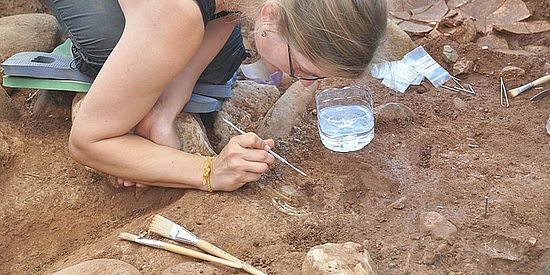
Archaeology and Natural Sciences (Master's Degree Program)An Innovative Synthesis of Cultural History and Scientific Methods
Scientific techniques for analysing the material traces of human culture have become indispensable to archaeological practice. The Master’s programme Archaeology and Natural Sciences – unique in Switzerland – responds directly to this development. It integrates the teaching of scientific methods with the questions, theories, and approaches of Egyptology, Classical Archaeology, as well as Prehistoric and Provincial Roman Archaeology. This interdisciplinary fusion of cultural history and natural sciences introduces students to a collaborative research culture and cultivates cross-disciplinary thinking and working.
Focal areas of teaching and research
The program prepares students for professional archaeological work grounded in solid expertise in Archaeological Sciences and interdisciplinary collaboration. In addition to practical training, it promotes a holistic research perspective in the spirit of integrative archaeology. Disciplinary strengths include:
- Archaeological Sciences (especially archaeobotany, archaeozoology, geoarchaeology, and archaeological anthropology)
- Egyptology
- Classical Archaeology
- Prehistoric and Provincial Roman Archaeology
The curriculum consists of modules in Archaeological Sciences and modules from one of the three specialisations: Egyptology, Classical Archaeology, or Prehistoric and Provincial Roman Archaeology. The elective and profiling component draws on the full breadth of courses offered in the Master’s programs in Archaeology and Natural Sciences and in the Study of Ancient Civilisations. It serves to consolidate existing knowledge in Archaeological Sciences and enables students to deepen and broaden their expertise in the ancient world, allowing for a flexible and individual academic profile.
A key element of this profiling is the Master’s project, ideally designed to bridge disciplines and methodologies. It comprises an internship and a subsequent project report. The Master’s degree program concludes with an interdisciplinary Master’s thesis and the final examination.
Brief profile
| Degree | MA in Archaeology and Natural Sciences |
| Type | Degree program |
| Start date | February, September |
| Credit points | 120 |
| Study structure | The Master's degree is the second degree after the Bachelor's degree. The Master's program comprises a total of 120 credit points (CP). 30 CP are earned in the specialization in Natural Science Archaeology, 40 CP in one of the three specializations Egyptology, Classical Archaeology or Prehistoric and Provincial Roman Archaeology and 10 CP in the supplementary and profiling area. The Master's examination and Master's thesis add up to a further 40 CP. One credit point (CP) ECTS corresponds to approximately 30 hours of work. |
| Combination of subjects | The Master's degree program in Archaeology and Natural Sciences is a so-called mono degree program without additional subjects. |
| Language of instruction | German, English |
| Department | Ancient Civilizations |
Master’s admission requirements
Admission to master’s programs is regulated by the university student regulations and the stipulations of the individual degree program descriptions. More details of the general master’s admission requirements are provided here.
For students to be admitted with no additional requirements, they must hold a bachelor’s degree worth 180 CP from a higher education institution recognized by the University of Basel.
Subject-related requirements are defined in the admission requirements (section 3) of the study program for the relevant subject. The guidelines may also contain further useful information that is key to successful studies.
Registration dates
Students must register for their bachelor’s or master’s degree program within a specified timeframe – even in cases of delayed registration.
Information events
The University of Basel organizes regular information events for bachelor’s and master’s programs. Details can be found on the events page of the Faculty of Humanities and Social Sciences.
Some subject areas also offer their own separate information or welcome events. Please consult the page for the relevant subject area for event dates and locations.
Deadlines and dates for the Master's studies
See also factsheets under Documents & Factsheets.
Master's thesis
Master's examinations for students of the subject and degree program
Master's degree
Fall semester 2025
All data subject to subsequent changes.
Career opportunities
Building on the existing specialization option "Prehistoric and Natural History Archaeology" in Basel - which is largely unique in the European university landscape - the changing needs in archaeological practice and research will be taken into account.
The Master's degree program prepares graduates - according to their disciplinary focus - for traditional and established professional fields in museums, monument preservation, cantonal archaeology, cultural management and national and international research institutions. The increased incorporation of scientific methods in the work of archaeological institutions (cantonal archaeology, archaeological services, etc.) opens up good career opportunities for graduates in this field of activity.
Academic advice
Natural science archaeology
Ancient Civilizations (Egyptology, Classical Archaeology or Prehistoric and Early Historic and Provincial Roman Archaeology)
Teaching commission
Quick Links