

Egyptology (Master's Degree Subject)A Comprehensive Exploration of Ancient Egyptian Cultural History
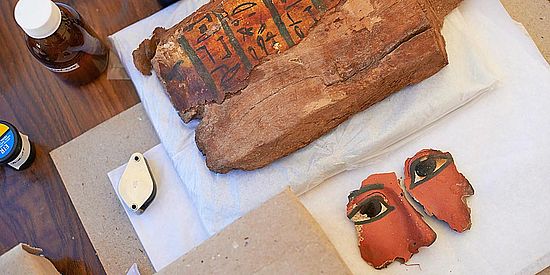
Egyptology encompasses the culture and history of Ancient Egypt from the Predynastic period (4th millennium BCE) to the Coptic Late Antique era. Its foundations rest on a rich corpus of textual sources – preserved in various linguistic and script traditions on inscribed monuments, papyri, and other media – and on the extensive material record, including temples, tombs, settlements, and objects such as sculpture, stelae, vessels, and furniture. Research seeks to reconstruct Ancient Egyptian culture in its full breadth; accordingly, the degree subject engages with historical, archaeological, social, religious, cultural, art-historical, literary, and linguistic questions. Language proficiency is expanded and deepened throughout the course of study.
Focal areas of teaching and research
The Egyptology degree subject at Basel is distinguished by its strengths in cultural studies, archaeology, and philology/linguistics. Teaching covers foundational areas including language (Classical Egyptian, Old Egyptian, Late Egyptian, Demotic and Coptic, together with hieratic and demotic scripts), as well as the history, religion, and monumental culture of all periods. Although the degree subject rests primarily on textual and literature-based study, it also includes excursions to museums and, where appropriate, participation in archaeological excavations.
Research at Basel focuses on archaeology (Valley of the Kings, Theban Necropolis, Deir el-Medina), religion (funerary practices and equipment, personal piety, ritual, funerary texts), history (social history, cultural contact), writing and iconography, as well as philology and linguistics.
Short profile
| Degree | MA in Egyptology |
| Type | Degree subject |
| Start date | February, September |
| Credit points | 120 |
| Study structure | The Master's degree comprises a total of 120 credit points (CP). In addition to Egyptology, students choose a second, independent subject. Both are studied for 35 CP each. The subject in which the Master's thesis (30 CP) is written becomes a major, the other a minor. In addition, there is the free elective area (20 CP). One ECTS credit point corresponds to approximately 30 hours of work. |
| Subject combination | A subject from the Faculty of Humanities and Social Sciences or a non-faculty subject can be considered as a second Master's subject. Students can choose it according to their interests and professional goals. The free elective area consists of freely selectable courses that can be used to deepen knowledge of the subjects, to gain insight into other subjects offered by the University of Basel or to acquire language skills. |
| Language of instruction | German, English |
| Subject area | Egyptology |
Prerequisite is a Bachelor's degree in Ancient Civilizations with a focus on Egyptology from the University of Basel or equivalent academic achievements to the same extent in the field of Egyptology from a university recognized by the University of Basel (including at least 12 credit points in language acquisition).
Master’s admission requirements
Admission to master’s programs is regulated by the university student regulations and the stipulations of the individual degree program descriptions. More details of the general master’s admission requirements are provided here.
For students to be admitted with no additional requirements, they must hold a bachelor’s degree worth 180 CP from a higher education institution recognized by the University of Basel.
Subject-related requirements are defined in the admission requirements (section 3) of the study program for the relevant subject. The guidelines may also contain further useful information that is key to successful studies.
Registration dates
Students must register for their bachelor’s or master’s degree program within a specified timeframe – even in cases of delayed registration.
Information events
The University of Basel organizes regular information events for bachelor’s and master’s programs. Details can be found on the events page of the Faculty of Humanities and Social Sciences.
Some subject areas also offer their own separate information or welcome events. Please consult the page for the relevant subject area for event dates and locations.
Deadlines and dates for the Master's studies
See also factsheets under Documents & Factsheets.
Master's thesis
Spring semester 2025
Master's examinations for students of the subject and degree program
Spring semester 2026
Master's degree
All data subject to subsequent changes.
Career opportunities
Graduates of Egyptology can pursue a doctorate and continue to work in the university sector, for example in research projects. This can include participation in excavations in Egypt as well as research stays at other universities or institutions. Further career opportunities are available in museums, cultural management, tourism (tour guiding for study trips), science journalism or publishing. Studying Egyptology is also a good basis for working in international organizations. Students also regularly take up non-specialist professions in the private sector, where their ability to familiarize themselves with complex issues and present them professionally in a linguistic manner comes into play.
Student advisory service
Teaching commission
Quick Links