

European History in Global Perspective (Master's Degree Program)A full degree in history with a research-oriented profile
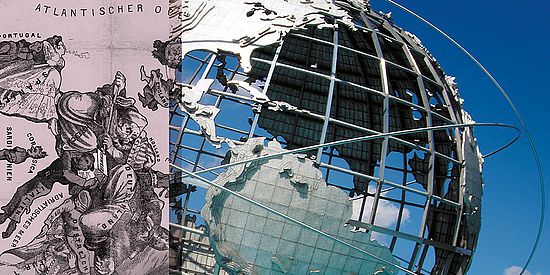
Europe is changing – its structures, foundations, and borders are being continuously reconsidered and reshaped. In light of the global historical turn, European history is also reinventing itself. Traditional temporal and territorial concepts are being questioned, while global interconnections and networks, transnational actors, and transcultural dimensions are moving into focus.
The Master’s degree program European History in Global Perspective at the University of Basel addresses the challenges of a European history that is reinventing itself and:
- connects European history with global historical perspectives,
- covers multiple historical epochs,
- promotes theoretical and methodological reflection,
- is research-oriented and offers partial integration with the doctoral programme (Basel Graduate School of History),
- allows students to pursue individual areas of specialisation,
- supports independent learning through project-based approaches,
- builds competencies in innovative research fields (e.g. Digital History),
- offers opportunities to study abroad,
- prepares students for a wide range of professional careers,
- enables students to undertake an independent research project (Master’s thesis).
«Research, reflect, apply – the MSG is history in its purest form. The Werkstatt Europa offers endless opportunities to develop and pursue your own ideas. Excursion, conference, source analysis – what kind of event would you like to organise one day?»
Marino Ferri, former Study Coordinator MSG
Short profile
| Degree | MA in European History in Global Perspective |
| Type | Degree program |
| Start date | February, September |
| Credit points | 120 |
| Study structure | The Master's degree is the second degree after the Bachelor's degree and comprises a total of 120 credit points (CP). The Master's degree course in European History in Global Perspective is a so-called mono course without further subjects, which is completed with 100 CP. In addition, there is the free elective area with 20 CP. One ECTS credit point corresponds to approximately 30 hours of work. |
| Combination of subjects | The Master's degree course in European History in a Global Perspective is studied without a second subject, but includes a free elective area worth 20 credit points. This can be used to deepen your knowledge of the course, for example for study abroad, the internship, for the acquisition of interdisciplinary skills and language skills from the module area "Transfer" or to gain an insight into other courses offered by the University of Basel. |
| Language of instruction | German, English |
| Department | Department of History |
Master’s admission requirements
Admission to master’s programs is regulated by the university student regulations and the stipulations of the individual degree program descriptions. More details of the general master’s admission requirements are provided here.
For students to be admitted with no additional requirements, they must hold a bachelor’s degree worth 180 CP from a higher education institution recognized by the University of Basel.
Subject-related requirements are defined in the admission requirements (section 3) of the study program for the relevant subject. The guidelines may also contain further useful information that is key to successful studies.
Registration dates
Students must register for their bachelor’s or master’s degree program within a specified timeframe – even in cases of delayed registration.
Information events
The University of Basel organizes regular information events for bachelor’s and master’s programs. Details can be found on the events page of the Faculty of Humanities and Social Sciences.
Some subject areas also offer their own separate information or welcome events. Please consult the page for the relevant subject area for event dates and locations.
Deadlines and dates for the Master's studies
See also factsheets under Documents & Factsheets.
Master's thesis
Spring semester 2025
Master's examinations for students of the subject and degree program
Spring semester 2026
Master's degree
All data subject to subsequent changes.
Career opportunities
The MA in European History in Global Perspective is an academic degree that qualifies students for a career and provides them with a high level of expertise specific to Europe in addition to general historical qualifications. It qualifies students for middle and upper management positions in numerous professional fields.
In addition to traditional careers in schools and universities, historians are also employed in the wider fields of culture, communication and media. They work in journalism, in museums, in libraries and archives, in public administration, in private service companies (namely banks and insurance companies) as well as in cultural, political, non-profit and international organizations and even in the diplomatic service.
Furthermore, the degree in European History in Global Perspective qualifies students for doctoral studies in history or related subjects.
Teaching diploma
Graduates who are interested in the teaching profession can study for a teaching diploma for the lower secondary level (Sekundarstufe I) or upper secondary level (Sekundarstufe II). For details and teaching diploma regulations, please consult the relevant school for teacher education (such as the FHNW School of Education) or the Swiss Conference of Cantonal Ministers of Education.
Student advisory service
Teaching commission
Quick Links